
Getting Started with Enterprise Architecture
- Next date 21–22 October 2026
- Format Online
- Language English
Overview
What the course covers
Course goals
Why start with Getting Started with Enterprise Architecture?
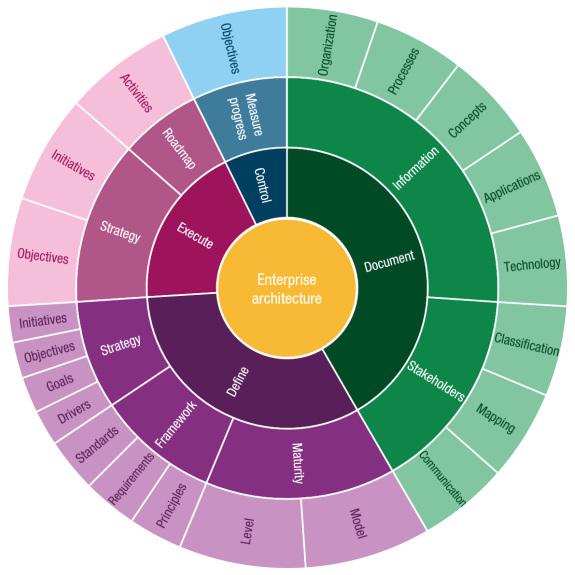
- Ideal first step in EA – the EAWheel is a simple, understandable, and easily adaptable methodology that requires no lengthy preparation.
- Quick wins – during the course, participants can already produce their first organization-specific architecture artefacts (e.g., stakeholder map, information map, portfolio map).
- Foundation for later expansion – provides a solid base on which TOGAF® framework or other, more complex frameworks can be built.
- TOGAF® framework compatible – fully aligned with the TOGAF® ADM logic, making it easy to integrate into existing or planned TOGAF® framework operations.
- Highly practical approach – the skills learned are immediately applicable in day-to-day work and support rapid organizational adoption.
- Aligns strategy and execution – helps ensure that top management and implementation teams speak the same common language.
- Sustainable operation – incorporates governance and measurement mechanisms so EA not only starts but also delivers lasting value.
Skills you will gain
Participants will be able to:- assess EA maturity and prepare for implementation;
- perform stakeholder analysis and create information maps;
- document the current architecture state;
- develop an architecture vision, target state, and concrete implementation plans;
- create a portfolio map and architecture roadmap;
- operate governance mechanisms and measure progress;
- use the EAWheel in conjunction with TOGAF® framework, tailored to their organization’s needs.
Schedule
Dates and prices
Every scheduled date follows the same syllabus; the language, the location and the price differ by date.
Audience
Who is it for
- business and enterprise architects,
- business analysts and process designers,
- project and program managers,
- IT architects and solution designers,
- executives and decision-makers who want to steer and align change at a strategic level.
Course content
Syllabus
1. Enterprise Architecture foundation modules
2. Understanding the EAWheel Structure
3. Document – Initial setup
4. Define – Capturing the current state
5. Execute – Planning the target state and implementation
6. Control – Governance and feedback
Book your seat in the next group
We work in small groups so that there is time for every question.

Who teaches it
Trainers

Eric Jager
Enterprise Architecture Trainer, Author of the book "Getting Started with Enterprise Architecture"

Gabor Sulok
Enterprise Architect, TOGAF® Trainer, Lead Consultant
Related courses
You may also like
Getting Started with Enterprise Architecture
This practical course is based on the Enterprise Architecture Implementation Wheel (EAWheel) methodology, which provides a visual and structured…
You are hereTOGAF® Enterprise Architecture Training – Foundation
This course provides an introduction to the TOGAF® concepts, structure, and the steps of the ADM cycle. It establishes the theoretical foundation…
View courseTOGAF® Enterprise Architecture Training – Foundation and Practitioner Combined
This intensive 4-day (4×8 hours) program combines the TOGAF® Enterprise Architecture Foundation (Part 1) and the TOGAF® Enterprise Architecture…
View courseTOGAF® Enterprise Architecture Training – Practitioner Bridge
This intensive 2-day (2×8 hours) officially accredited course, approved by The Open Group, is designed exclusively for professionals who already hold…
View coursePrivate training for your team?
Any of our courses can be delivered as a private, in-company training, tailored to your organisation, in English or Hungarian.
Request a quote